Learning Outcomes
i. Students will be able to explain the basic reactivity pattern of amines.
ii. Students will be able to identify the different types of reactions that amines can undergo.
iii. Students will be able to predict the products of amine reactions.
Introduction
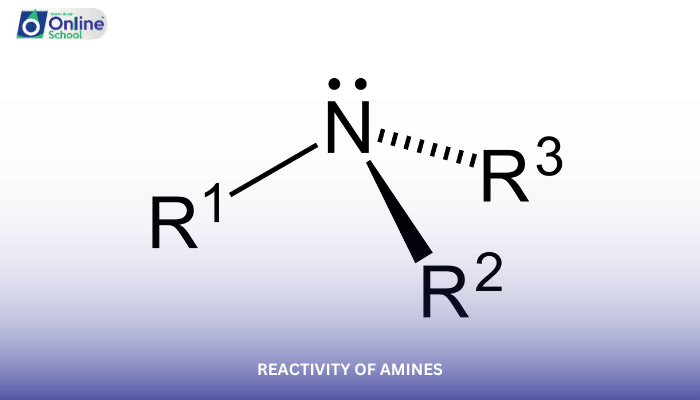
Amines are a class of organic compounds that contain a nitrogen atom bonded to one or more alkyl or aryl groups. Amines are found in a wide variety of natural and synthetic products, including pharmaceuticals, dyes, and plastics. Amines are also important intermediates in many organic syntheses.
The reactivity of amines is determined by the presence of a lone pair of electrons on the nitrogen atom. This lone pair of electrons makes amines nucleophilic, meaning that they are attracted to positively charged atoms or groups. Amines can react with a variety of electrophiles, including acids, alkyl halides, and carbonyl compounds.
i. Basicity of Amines
Amines are basic compounds, meaning that they can accept protons (H+ ions) from acids. The basicity of an amine depends on the number of alkyl or aryl groups attached to the nitrogen atom. Primary amines (amines with one alkyl or aryl group) are the least basic, secondary amines (amines with two alkyl or aryl groups) are more basic, and tertiary amines (amines with three alkyl or aryl groups) are the most basic.
ii. Alkylation of Amines
Amines can react with alkyl halides to form alkylated amines. This reaction is known as alkylation. The alkylation of amines is an important reaction in organic synthesis, as it allows for the introduction of alkyl groups onto the nitrogen atom.
iii. Acylation of Amines
Amines can react with acyl chlorides or anhydrides to form amides. This reaction is known as acylation. The acylation of amines is an important reaction in organic synthesis, as it allows for the introduction of acyl groups onto the nitrogen atom.
iv. Diazotization of Amines
Primary aromatic amines can react with nitrous acid (HNO2) to form diazonium salts. This reaction is known as diazotization. Diazonium salts are important intermediates in the synthesis of a variety of organic compounds, including dyes and pharmaceuticals.
v. Reduction of Amines
Amines can be reduced to form alkanes or amines with fewer alkyl or aryl groups. The reduction of amines is an important reaction in organic synthesis, as it allows for the removal of alkyl or aryl groups from the nitrogen atom.
Amines are a versatile class of compounds that undergo a variety of reactions. The reactivity of amines is determined by the presence of a lone pair of electrons on the nitrogen atom. This lone pair of electrons makes amines nucleophilic, meaning that they are attracted to positively charged atoms or groups. Amines can react with a variety of electrophiles, including acids, alkyl halides, and carbonyl compounds.
